 |
 |
 |
Prolongation: Basic Analysis of Chorale Harmonization (Part Five) |
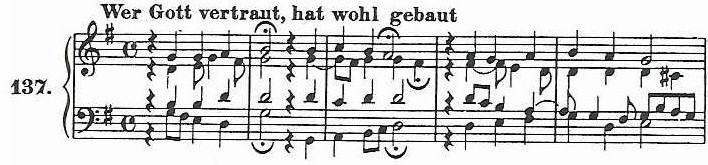
| Example 225.1 is a cadential structure analysis of the entire chorale. We have covered the analysis in 225.1(a). In 225.1(b), a broader analysis shows groups of two and three phrases and their cadential significance. In 225.1(c), the same prolongation of the tonic occurs three times; in its second occurrence, it is stretched out over several phrases which include a passage in the submediant. |
| Example 225.1 |
| Next: Cadential Structure Analysis, Part Four Back: Part Four |
| [ I - V I ] |
| [[ I - I ] V ] |
| [[ - - - I ] - - - - > |
| > V ] |
| [[ I - I ] V ] |
| [[ - I - - I ] IV V I ] |
| [[ - I - - I ] IV V > |
| e: [[ I - I ] V ] |
| > I ] |
| G: [[ - I ] IV V I ] |
| [[ I - I ] V ] |
| [[ - I - - - - - I ] V |
| [[ - I - - I ] IV V I ] |
| [ I V] |
| [ V I] |
| [[ I - - - - - - - - - - - - - - - - > |
| > - - - I ] IV V I ] |
| > |
| e: [[ - - - - - V ] > |
| > I ] |
| G: [ I V] |
| [ V I] |
| (a) |
| (b) |
| (c) |
| (a) |
| (b) |
| (a) |
| (b) |
| (c) |
| [[ - I - - I ] IV V I ] |
| [[ - I - - I ] IV V I ] |
| The analysis in example 225.1(b) shows a balancing of half-cadence phrases with full cadence phrases. Consequently, the first two phrases function as a half-cadence ([I-V]), and the next two phrases function as a full cadence ([V-I]). The total result is that the first section of this chorale is a full cadence ([V-I]) anchored in two sets of balanced phrases. Combined with the staid rhythm, this projects a mood of well-grounded tranquility. |
| The middle section, after the repeat sign, deviates from this pattern by grouping two short phrases, both ending in a dominant, with a longer phrase concluding on a tonic. This middle section comes to rest, seemingly, as a full cadence in e minor. The very next phrase re-establishes G major by revealing that e minor was part of a prolongation of the G major tonic. |
| The last four phrases exhibit a balance similar to the first four. |
| The analysis in example 225.1(c) shows how the process of prolongation integrates a divergent element - in this case, a modulation to e minor - into a well-balanced whole. In this particular example, the seeming modulation to another key is a simple variation on a pattern that occurs twice elsewhere in the harmonization. In symphonic composition generally, the relationships are not usually so obvious. |
| RIFFS Cadential Structure Prolongation of Function Lester Allyson Knibbs, Ph.D. |
 |
Introduction The Chaconne Cadential Structure --- Unitary & Binary Structures Linear & Periodic Structures Riff Modalities Structural Counterpoint Modular Composition Appendices |