 |
 |
Prolongation: Basic Analysis of Chorale Harmonization (Part Three) |
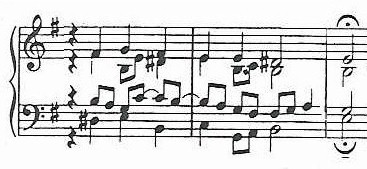
| The fifth and sixth phrases (example 223.1), both half-cadences, are here analyzed in two different keys, G major and e minor. This is misleading, but is done because of the parallel harmonization between the fourth phrase (a full cadence in G major) and the seventh phrase (a full cadence in e minor). As will be shown, this excursion into e minor is not a modulation from the home key but a prolongation of the home key's tonic. |
| Example 223.1 |
| [[ I - - I] V ] |
| Example 223.2 |
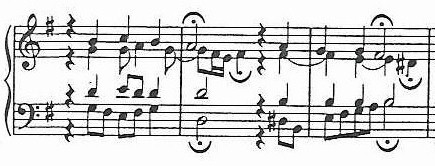
| e: [[ - I - - - - I] IV V I ] |
| The seventh phrase (Example 223.2) is a full cadence in e minor, almost identically parallel to the full cadence in G major that constitutes the fourth phrase. Seemingly, the chorale has modulated to a new key, the submediant. But watch the magic of the following phrase (in example 224.1). |
| Next: Cadential Structure Analysis, Part Four Back: Part Two |
| e:[[ - - I ] V ] |
| RIFFS Cadential Structure Prolongation of Function Lester Allyson Knibbs, Ph.D. |
[I-IV-V-I] Prolongation: Back / Next Elaboration of Motion In Symphonic Composition |
 |
Introduction The Chaconne Cadential Structure --- Unitary & Binary Structures Linear & Periodic Structures Riff Modalities Structural Counterpoint Modular Composition Appendices |