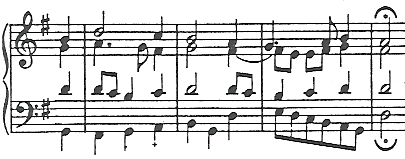
The last phrase (example 214.2) ends exactly as did the second phrase, a full subdominant-dominant-tonic cadence. The first five quarters of this phrase, however, set forth new voicings of familiar chords. One of the delightful characteristics of this harmonization is the recurrence of identical voicings and similar sonorities. The tonic chord at the end of m. 3 returns no less than eight times in that identical voicing, and three more times with a b-natural replacing the g-natural in the bass. The dominant chord at the end of the first phrase returns five times. The constant return of similar or identical voicings is more the rule than the exception in this harmonization. Consequently, the newly introduced opening voicings of the last phrase stand out.
Another difference in this last phrase is that instead of prolonging the initial structural tonic this phrase uses an elaborated motion from the initial tonic to the structural subdominant. I prefer the first analysis (214.2(a)) in which the structural subdominant is not reached until the halting motion in the bass reaches the low c-natural. This interpretation is supported by the change in both melodic direction and rhythm at that point, as well as by the return of familiar chords, voiced to emphasize the idea of recapitulation at the conclusion. In the alternate interpretation (214.2(b) and (c)), the structural subdominant is reached on the e-natural in the bass and prolonged for three quarters. I do like this idea, for a number of reasons, among them: (1) it provides a nice counterpoint to the meter; and (2) prolongation of the structural subdominant is often an exciting process in larger works. But aside from the first-inversion subdominant chord, this interpretation is not well supported in this instance.
|